

Eagles flight the chroni.., p.1
Eagle's Flight (The Chronicles of Adalmearc Book 1), page 1


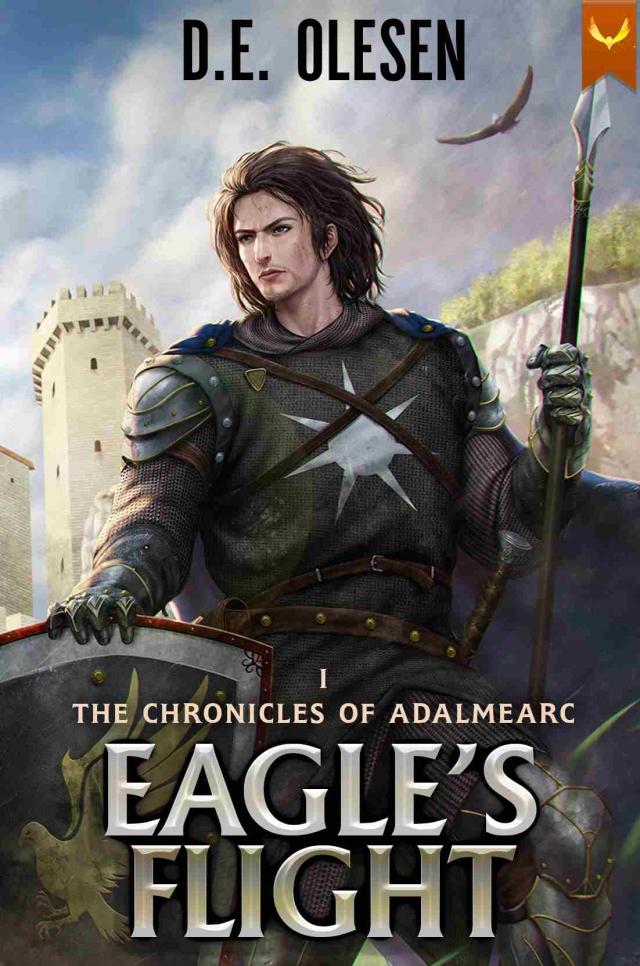
EAGLE’S FLIGHT
©2024 D.E. OLESEN
This book is protected under the copyright laws of the United States of America. No part of this publication may be reproduced, stored in a retrieval system, or transmitted, in any form or by any means, without the prior permission in writing of the publisher, nor be otherwise circulated in any form of binding or cover other than that in which it is published and without a similar condition including this condition being imposed on the subsequent purchaser. Any reproduction or unauthorized use of the material or artwork contained herein is prohibited without the express written permission of the authors.
Aethon Books supports the right to free expression and the value of copyright. The purpose of copyright is to encourage writers and artists to produce the creative works that enrich our culture.
The scanning, uploading, and distribution of this book without permission is a theft of the author’s intellectual property. If you would like to use material from the book (other than for review purposes), please contact editor@aethonbooks.com. Thank you for your support of the author’s rights.
Aethon Books
www.aethonbooks.com
Print and eBook formatting by Steve Beaulieu.
Published by Aethon Books LLC.
Aethon Books is not responsible for websites (or their content) that are not owned by the publisher.
This book is a work of fiction. Names, characters, places, and incidents are the product of the author’s imagination or are used fictitiously. Any resemblance to actual events, locales, or persons, living or dead is coincidental.
All rights reserved.
CONTENTS
Also in Series
Preface
1. Journey’s End
2. When Eagles Sleep
3. Young Man’s Folly
4. Rats Will Reign
5. Midsummer Sun
6. The Voice of the Adalthing
7. A Highland Tale
8. Ælfwine
9. The Long Watch
10. The Bonds That Bind Us
11. Men May Ride
12. But the Raven Will Fly
13. Sigvard’s Blood
14. Bated Breath
15. The Dragons of Wyrmpeak
16. A Breach of Sanctity
17. Night of the Knife
18. Ember and Ash
19. The Sorrow of Glen Hollow
The Nobility and People of Adalrik
Thank you for reading Eagle’s Flight
ALSO IN SERIES
Eagle’s Flight
Serpent’s Strike
Raven’s Cry
PREFACE
Let all who read these chronicles know that this tome was written at the command of King Sigvard the Second in the fourth year of his blessed reign. He that is High King of all the realms of Adalmearc, the Dragon of Adalrik, and rightful atheling of Sigvard Drakevin.
Long may he reign.
Within is contained all that is known concerning the Great War and the years before, during, and after. Let it serve to instruct future generations, to inspire them through the great deeds performed, to warn them by examples of treachery endured, and to teach them to remain true to their oaths, the Codex, and the Alfather, by whose hand all is accomplished.
Thus write I, Quill, the king’s scribe
First Chronicle of Adalmearc
The year is one thousand and ninety-seven
The events unfold in the realm of Adalrik
1
JOURNEY’S END
MIDDANHAL
All roads eventually led to Middanhal. Silk, spices, ivory, cotton, and precious gems first reached the city-state of Alcázar before travelling by ship north through perilous seas to arrive at the shores of Adalmearc. For some, the journey ended here, selling their goods for others to transport further on and, in turn, buying wool, linen, timber, and dye to bring back. Others moved from seagoing ships to river transports and continued further inland, forming a convoy of various travellers banding together for comfort and safety. It took weeks of sailing on the rivers upstream, and often the ships were pulled by spans of oxen walking on the riverbanks.
Eventually, one reached Coldharbour, the northernmost port on the river near its source in the mountains. Here, all would have to disembark, goods and passengers alike, pay the toll, and continue on foot, horseback, with mules, or on cart. It was fifty miles from their destination as the arrow flew, but to be near fresh water, the road followed the curves of the river as it snaked through the landscape. This nearly doubled the final journey. The caravan would also increase in size as pilgrims, priests, peasants, and other people joined it.
Finally, their destination began to appear. A great chain of mountains ran from west to east through Adalmearc, broken only in one place. There, situated on a hill dwarfed by the mountain peaks directly to the east and west of it, lay Middanhal. From afar, one could spy its impregnable walls with towers and buildings rising on the hill behind those fortifications. Coming closer, the gate itself would be in view. When closed, steel doors with intricate carvings blocked the entrance to the city, but during the day, the gate was opened and allowed entry.
The city guards inspected all who entered, and they collected toll as people passed through. The gate was wide enough that twenty men could stand shoulder by shoulder with ease, and the road beyond had the same width. It was the main street in Middanhal, named Arnsweg, in honour of the king who built it. First, it passed through what was simply called Lowtown, the neighbourhoods between the outer walls and the river that coursed through Middanhal. Although the smallest part of town, twice as many people lived here than in the rest of the city; it was home to the poor, the servants who served others, and the beggar priests who, in turn, served them.
While the outer walls marked one end of Lowtown, a natural boundary between the poor part and the rest of the city was provided by the large river Mihtea that flowed through the city. Only the Arnsweg and its stone bridge gave passage further into the city. Moving beyond Lowtown and up along the Arnsweg, travellers would enter the city proper. Here they would find the shops and workshops of ordinary trade, and in the western part lay the warehouses and merchants’ quarter.
Reaching this point, traders from Alcázar would turn left and leave the Arnsweg, bringing their exotic goods to their stores in the small section designated for foreign merchants. There they might give thanks to their heathen gods for a safe journey, unload their cargo, and in turn, pick up iron ore as well as silver, jewellery, and the expertly crafted tools for which Middanhal was famous. Merchants of the caravans who were native to Adalmearc would separate as well, each seeking his own storehouses. Any remaining travellers of the original convoy would continue along the Arnsweg until reaching the Temple square and the heart of Middanhal.
Placed directly in the centre of the city lay the holiest of temples, the Temple of the Alfather. None other was allowed dedication to Him, most high of all. The square itself would be full of people, serving as a marketplace with stalls and people offering their goods. A steady stream of pilgrims and supplicants would move forward to the Temple itself, as would ordinary travellers, simply wishing to express their gratitude for reaching a long journey’s end. For some, it meant hours of waiting, though a knight and his squire with the dust of Alcázar on their cloaks might push their way through the throng.
Some needed to go further still. At the Temple square, the Arnsweg divided itself. One branch led northeast to the quarter populated by the nobility and their mansions. The other branch moved northwest, leading to the quarter of specialised workshops, forges, and craftsmen that worked iron into arms and armour primarily. The city’s small enclave of Dwarves lived primarily here, staying together for comfort and safety. Beyond these buildings, the Arnsweg moved alongside the other structure that dominated Middanhal. To the northwest lay the great fortress known as the Citadel.
It was an immense construction, larger even than the Temple complex. Its northern part was closely tied to the city walls and gate, adding its defences to those fortifications. Here the city guard resided and, more importantly, the Order of Adal. Thousands of knights and tens of thousands of Order troops were controlled from those halls, and every day, knights and soldiers arrived from or departed to their postings.
The southern part of the Citadel was reserved for the king, his family, his court, and the nobility. On the lower levels lived the servants by the kitchens and everything else that made life possible within the stonewalls. Below were the dungeons, and above were the residences for the court and nobility. Nobles without their own house in the city might be quartered here as the king’s guests along with the rest of the court. Furthest up were the royal chambers, reserved for the king and his kin as well as his personal servants.
The library tower was placed in close vicinity and had its own entrance so a visitor would not need to enter the royal residence. A lone traveller now walked this way, this final distance of a long journey. He wore a hat as cover against the sun, a cloak to ward off cold and dirt, and a simple walking staff in his hand for support. His paper of passage gave him admittance to go through the gate of the Citadel and up the winding stairs.
The tower was specifically built to allow as much sunlight to enter as possible, but only in angles onto surfaces where no books were kept that might decay in the light. Special alcoves contained torches to illuminate the tower after
This was the domain of the Quill, the king’s scribe. He maintained the old books, wrote new ones, added to the annals, and was the expert on all matters pertaining to the laws of the realm. The current Quill wore a robe much like the priests at the Temple, dark red in colour, and had hands stained by ink; his skin was bronze, however, and his curly hair and beard were black if lightly touched by grey. He was a native of Alcázar and had taken the journey to Middanhal decades ago as a young boy, ending up as apprentice to the King’s Quill of that time. Now he had succeeded his master and had an apprentice of his own.
His long, slender fingers were gently repairing the binding on a book entitled Herbs of the Realm and Their Uses when a vague gust of wind raised a few of the pages into the air before once again descending. This announced as sure as any bell that the door had been opened, and Quill raised his head slightly. “Is that you, boy?” His voice came as soft as the feathers on the quill for which his position was named.
“Try again.” The other voice sounded younger yet held far more weariness. It came from the inner hall of the tower, where the many books were kept and to which the scriptorium was adjacent. At the sound of this voice, Quill rose so abruptly he almost toppled his chair. He turned to face his guest as the latter entered the scriptorium.
“You have returned. When I did not hear from you these last many months, I wondered…”
“It would take a lot to silence me permanently,” the visitor said dryly, placing his walking staff against a wall. They both extended their hands and clasped them around the other’s in greeting before separating again.
“Sidi,” Quill greeted him, speaking a word in the tongue of Alcázar and bowing slightly. Although he addressed the stranger in his own tongue, his guest did not resemble the Quill. While the stranger’s hair was also dark, it was completely straight, and his skin appeared to be less tanned. No white streaked his hair, nor did wrinkles crease the newcomer’s skin. He seemed completely unmemorable except in one respect. His eyes were of indeterminable hue, and his age would be difficult to guess with certainty.
“We are not in Alcázar,” the stranger said with a vague smile.
“Godfrey, then,” Quill acknowledged. The stranger inclined his head as if greeting Quill from anew.
“You did not receive my latest missive, I take it,” Godfrey said.
Quill shook his head. “What did it say?”
“Alcázar is buying lumber in great quantity.”
“Not much of a message,” Quill said, “but enough to condemn your messenger.”
Godfrey nodded. “They must have kept me under observation. Probably watched all travellers arriving from the north stepping onto the docks.”
“But you are certain? Both about the quantity and its purpose?”
Godfrey nodded again. “The ship I took south carried lumber. The ship on which I stowed away northbound had taken a cargo of lumber to the city. Thankfully it carried wine back north, which made for a more pleasant hideout,” he added with a smile.
“And the purpose?”
“I saw the ships under construction. Deep keels. Even if I had not, there could be no doubt. Why else intercept my message, kill my messenger? Why else seek to apprehend me?”
“So it is to be war, then.” Quill spoke these words with a hint of a quiver betraying emotions that did not show on his face.
“I believe so. Maybe not within the first year or two, but eventually,” Godfrey declared.
“If I had received your letter, I would have advised the king to ban all further sale of timber. Alas, as it stands now…” Quill said, raising his tanned hands in a gesture of defeat.
“Yes, I heard when I landed back in Adalmearc. I have told our man in Thusund. He will get the trade blocked, though the damage is done. Enough of this – tell me what happened to the king. Travelling on the road, I have only heard unreliable rumours.”
“Let us sit down,” Quill spoke, beckoning towards a small table with a chessboard upon it and two small chairs.
“Playing a game?”
“Against my apprentice,” Quill said, taking the seat of the black player. “That reminds me… Egil!”
“You are losing,” Godfrey muttered and took the seat opposite. A boy of fourteen years appeared in the doorway of the scriptorium.
“Yes, master?”
“Did you fetch the parchment?”
“Yes, master.”
“Bring water for me and our guest. Then practise your letters,” Quill told him.
“Yes, master.” There was silence while the boy did as commanded, filling two cups with water and bringing them into the scriptorium. He placed them on the small table, careful not to disturb any of the chess pieces, before departing silently.
When they were alone again, Godfrey took a sip of his water and then looked at Quill. “You finally chose an apprentice.”
“He seemed like the brightest of the novices in the Temple,” Quill confirmed.
“A Temple novice? He is an orphan?”
“As they tend to be, yes.”
“And so his only ties are to you,” Godfrey said with a sly smile.
“His conditions are better here,” Quill said while hiding his face with his cup. “In the Temple, he would be one scribe of many. Here, eventually, this tower will be his sole domain.”
“Does he know about me?” asked Godfrey. Behind the cup, Quill’s expression froze.
“Not yet. I will tell him soon, now that he has met you.”
“The king,” Godfrey said in an abrupt change of subject. “Inform me,” he commanded.
“It was some months ago. The norns say it was old age, but he could easily have lived another twenty years,” Quill stated. “He simply wasted away these last few years. Ever since the death of his son.”
“How did the prince die at such a young age?” Godfrey asked Quill. “I have heard rumours, but nothing I would consider reliable.”
“Ambushed and killed in the highlands. It was what sparked the revolt among the clans.”
“I have been away too long,” Godfrey mumbled to himself. “He had a son himself, I seem to recall. How old is the boy? The king’s grandson,” he elaborated.
“Some eleven years, I think. Ten years too young to succeed.”
“But he is the only heir, is he not? If I remember correctly,” Godfrey frowned, “the late king has no other children or grandchildren.”
“No, the blood of Sigvard runs thin. There are two other houses descended from Sigvard,” Quill explained, “but they are cadet branches and have no support to make any claims. As things stand, our eleven-year-old prince is the only heir.”
“And yet he cannot take the throne until he is twenty-one. Tell me, law keeper, what happens in the next ten years until that takes place?”
“At the next Adalthing, the jarls will elect a lord protector to rule until the young prince is of age to be crowned,” Quill told his visitor.
“For ten years,” Godfrey said contemplatively. “The lord protector will have ten years as ruler of the realm…”
“The Adalthing assembles at summer solstice,” Quill told him. “Only a few weeks from now.”
“I need to travel into the East,” Godfrey said. “But I think I can delay for a few weeks. I have to go find lodgings before the city is overrun by pilgrims.”
“You are welcome to stay in the Citadel as my guest,” Quill protested. “I am sure…” He was silenced by Godfrey’s raised hand.
“A modest inn somewhere will suit me fine. I could use a few silver coins, though,” Godfrey said expectantly, and they rose from the table. Quill walked out of the scriptorium, followed by his visitor. He opened a drawer, took out a pouch, and poured some of its content into Godfrey’s open palm, who accepted with a nod. “We will meet again soon,” Quill’s visitor said as he adjusted his cloak around him, took his staff, and left with speed.
A faint breeze made it clear that Godfrey had opened the door and was gone. “How much did you hear?” asked Quill.






