Bully pulpit, p.1
Bully Pulpit, page 1


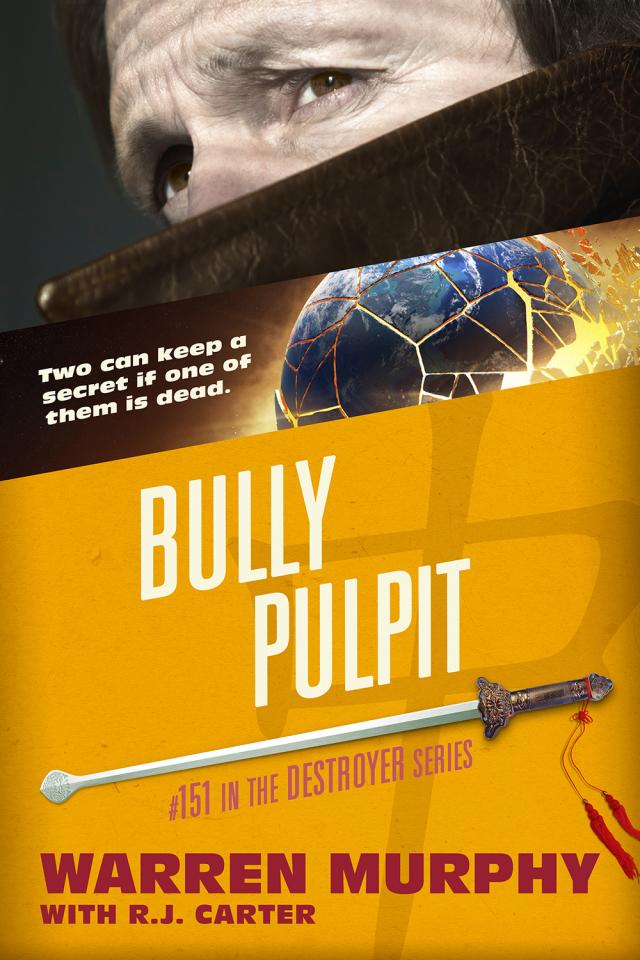
Bully Pulpit
The Destroyer #151
Warren Murphy
with
R.J. Carter
Contents
Bully Pulpit
Dedication
Chapter One
Chapter Two
Chapter Three
Chapter Four
Chapter Five
Chapter Six
Chapter Seven
Chapter Eight
Chapter Nine
Chapter Ten
Chapter Eleven
Chapter Twelve
Chapter Thirteen
Chapter Fourteen
Chapter Fifteen
Chapter Sixteen
Chapter Seventeen
Chapter Eighteen
Chapter Nineteen
Chapter Twenty
Chapter Twenty-one
Chapter Twenty-two
Chapter Twenty-three
Excerpt
About the Authors
Also by Warren Murphy
Copyright
Errata
To Jeffery O’Neill Lynch,
whom I’ve never met.
But he introduced Remo to Keith Sweet,
who introduced him to me.
—R.J. Carter
Warren Murphy is gone, but will never be forgotten.
In Memoriam: Warren Murphy
September 13, 1933—September 4, 2015
Chapter One
Nobody walks in Los Angeles. If Jacob Riser had been walking, he would have looked suspicious. But Jacob Riser was not walking. He was running, which was a certified heart-healthy activity, and was therefore perfectly acceptable—as well as eminently ignorable—even at three in the morning.
Jacob’s lungs burned as he gasped for air in the oxygen-deficient atmosphere of the big city. It might have gone easier for Jacob if he’d done more running in his life, but it had been twenty years and several thousand cigarettes since his last sprint.
Most people ran because they wanted to live longer, and that was certainly true in Jacob’s case as he rounded a corner blindly, his second-hand Florsheims desperate to find traction on the concrete.
Several yards into a narrow alleyway, Jacob squatted behind a dumpster, willing his heart to slow, his wheezing to silence. He glanced at the opening to the alley through a narrow aperture afforded between the back of the dumpster and the brick wall it abutted.
As he began to let himself believe he had escaped, that his pursuer had been evaded, he opened once more the manila folder he had been clutching to his chest. It was proof—proof, damn it!—that he was right this time, that he’d finally pegged that bastard after so many mistakes. But, oh God, how could the man be this evil? He had to be insane. There was no explanation, no reason, no profit in this. It staggered the mind.
Fingers shaking, Jacob fumbled in his jacket pocket for his cell phone, thumbing through the directory for the first person he thought might listen to him.
The sound of the phone warbling on the other end echoed like a klaxon in the alleyway, and Jacob quickly cupped his hand over the speaker, his heart swelling up into his throat.
A dozen rings later, an older and decidedly crabby voice came on the line. “Who the hell is this and why the holy hell are you calling me at the ass crack of dawn?”
“Schultzie,” Jacob whispered into the phone. “Schultzie, it’s me. It’s Jake. From The Clarion. Remember?”
“Jake?” There was a groan in his voice that said Schultzie would have much rather been awakened by a telephone solicitor. “Aw, holy cripes, Riser, is that you? I thought you were out west stalking celebutantes for crotch shots.”
“Schultzie, listen,” Jake persisted. “I got him. I finally got that son of a bitch.”
There was a long pause on the other end of the phone. “Jake, if you got me up just to give me another cockamamie conspiracy on…”
“This is real, Schultzie! It’s unbelievable, but…”
“Yeah, well, after the last time that doesn’t really surprise me.”
Jacob closed his eyes and took a breath. “Okay. Okay, I deserve that. But listen…”
“No. No, you listen, Jake,” Schultzie interrupted. “I stood up for you last time. I put my friggin’ reputation on the line, you remember that? I stood up and I told that editorial board, ‘Jake’s a decent guy and a hard working reporter. If he says there’s monkey business going on, then by God you better believe there’s monkey business going on.’ I pushed for you!”
“I…I remember, Schultzie.”
“I was lucky—damn lucky—that they didn’t shitcan me when it all hit the fan. Damn lucky they didn’t decide to include me in that lawsuit, though they might as well have. I’ve been paying for your screw up ever since! You’ve been a shit stain I can’t wash out.”
“Schultzie,” Jacob pleaded. “This isn’t like that! I swear.”
“Jake, honest to God, I don’t care if you have pictures of him in bed with farm animals. You burned me once. You’re not going to do it again. Call someone else.”
“There isn’t…” The phone showed the call had terminated. “…anyone else,” Jacob finished weakly to the dead connection.
He slipped the phone back into his pocket. He’d stayed in one place too long already. He needed to keep moving. With complaints from both knees and a sharp stitch in his side, Jacob pulled himself into a standing position, just in time to see his pursuer standing silhouetted against the streetlight at the opening of the alley.
Jacob wheeled and sprinted down the alley, wheezing as every fiber of his being struggled for survival. He’d gone about twenty paces when the bullet cut through his lower spine and burst out his gut. His legs lost all the signals from the rest of his central nervous system, and inertia face-planted him into the pavement with all the mercy gravity could muster, which was none. The cartilage of his nose popped like a balloon filled with raspberry jelly.
Jacob lay there, unable to move, unable to see beyond the fireworks on the back of his eyelids. He heard the unhurried, measured footsteps of his killer approaching, heard the click of the .38 snub-nosed revolver’s hammer being pulled back, and heard the pop of the bullet leaving the barrel as his body jerked once more. Each labored breath expulsed thick, viscous fluid now, and every nerve in his body screamed in pain.
He felt the manila folder pulled free from beneath his body as his killer tugged at an exposed corner. If Jacob had it in him to care at that moment, he would have pondered how his impending death was only going to be the insignificant first of so many, many more, and not long from now.
“Alas! for that day is great, so that none is like it: it is even the time of Jacob’s trouble; but he shall be saved out of it.” His killer’s voice was soft but sonorous, practiced from years of public oratory. “And another prophecy is thus fulfilled. I thank you for that, Mister Riser.”
Jacob burbled as he felt a hand slip into his back pocket and pull out his billfold. His killer availed himself of the forty-two dollars inside, letting the emptied soft leather fall conspicuously to the ground beside Jacob’s prone body before walking calmly away.
A short distance away, he heard a female voice. “We would have done that for you, honey,” the voice said. “It would have been faster.”
“I couldn’t let you do that,” the killer said ruefully. “My soul’s already damned. I don’t have the right to condemn yours.”
Five minutes later and three blocks north, a homeless man with a sign declaring he could not find a job, an education, or a meal, yet who had no difficulty in locating a clean piece of cardboard and a magic marker, found himself suddenly blessed with two twenties and two singles, and readied himself for a breakfast of liquid gold.
As Jacob’s mind began to shut down, his fingers reached outward, grasping for the cement foundation of the wall beside him. His fingers slick with blood, he had neither the time nor the cognition to leave a detailed message, or even a name, for whoever would find his body. Instead, he painted the last solid fact he could focus on, the single-most important thing he had ever learned: 1:49. And then his arm fell, as Jacob’s last breath rattled past his lips, blowing one final bubble of blood.
But who could decipher the meaning of the numbers in time? Who could possibly stop the coming apocalypse?
Chapter Two
His name was Remo, and thought he had sworn off smoking forever.
He was ambling along a crowded sidewalk. It was quiet, eerily calm, as he passed storefronts boarded up the way he had seen businesses do in advance of a hurricane. But there was no hurricane bearing down on Archway City, which was a thousand miles from any coast. It was something worse: a mood, a hive mind mentality that created a tension that was almost tangible. There were several police on hand, but they were all barricaded in their vehicles. Remo tapped on one of the patrol car windows, and an officer rolled it down an inch.
“Yeah, what do you want?”
Remo put his palms up, keeping them in plain sight so the officer would feel there wasn’t a threat. “Just wanted to get a sitrep.”
“Sitrep?” the officer asked. “Oh, the situation. Nothing confirmed yet, but word is the grand jury is going to announce any minute. And if it goes the way I’m hearing, you might want to get inside where it’s safe.”
“Think it’s going to get that bad, huh?”
“Worse,” the officer replied.
Remo looked around. “So where are you guys hiding the riot gear, or the paddy wagons for all the arrests?”
“Arre sts?” the officer laughed. “There won’t be any arrests. We’ve got orders to stand down and let the citizens express themselves. Any action on our part will be interpreted as an abridgment of their First Amendment rights to free speech.”
The Constitution wasn’t something the officer had to explain to Remo. He’d been defending it for some time now—usually by violating it. In what had seemed a simpler time, Remo had been a beat cop himself, back in Newark. Then one day he blinked, and found himself in prison on a trumped up charge that landed him on death row. As his fellow inmates served out decades, living on appeal after appeal, Remo was sent to the electric chair, where he was summarily executed.
Instead of awakening to Saint Peter and sweet angel harps, Remo woke up in a hospital bed from a medically induced coma to the irritating shrill insults of an ancient Korean. He learned from a dour man named Harold W. Smith that his identity had been eradicated so that he could serve as the enforcement arm of CURE, an agency created by the past President to exist outside of the Constitution in order to defend it in ways that it couldn’t do itself. To do this, he would be trained by Master Chiun, the Korean whom he was sure hated him for no good reason at the time, in the assassin’s art of Sinanju. And, for the good of the United States of America, Remo had accepted the offer.
Since that time, he had encountered a number of weird and unbelievable atrocities, but few of them ever topped human nature at its pure nastiest.
· · ·
Downtown, several miles from Remo, a battalion of media cameras and reporters were gathered on the steps of the courthouse. At this very moment, as the last sliver of sunlight slunk behind the western horizon, the special prosecutor was about to announce to the world that the grand jury had found no credible evidence to indict Officer Eric Ritter in the shooting death of eighteen-year-old Demond Wilcox. Despite the distance, those comments sparked a fuse that sizzled at the speed of social media, making a beeline for the northeast suburban neighborhood, almost directly to the mound of dead flowers, candles, and a rain-matted teddy bear—centrally laid out around a 40 ounce bottle of beer, marking the spot in the street where Wilcox breathed his last.
The fuse may not have been real, but the explosions were—very real. A shouting, angry mob appeared nearly spontaneously. The police officer Remo was talking to rolled up his window, and the rest obeyed their orders and sheltered in place while the protestors threw bottles, broke windows, flipped cars and chanted bad poetry at the top of their lungs.
The first building went up in flames within minutes, a bakery owned by an old man who gave out free cupcakes to the neighborhood children who came in on their birthdays. Remo stood on a corner against a light pole, disappointed that humanity didn’t disappoint him, as he watched the flames climb higher into the sky. The absence of sirens told him nobody was coming to save this structure, and the absence of screaming told him there was nobody inside—this time.
Remo glanced up and down the street, counting heads and giving a low whistle. It was painfully obvious that there were more people charging about than made up the population of the neighborhood.
This wasn’t protesting authority, Remo realized. Protesting authority was the sperm and egg of America. This was madness—with coordination.
He let out a deep sigh, and then tilted his head slightly to the right to allow a bottle of what Remo hoped was lemonade sail past him to smash on the sidewalk further away. The immediate ammonia and asparagus smell emanating from the bottle’s impact evaporated any hopes Remo had that it was merely a waste of a refreshing fruit drink. He turned, and saw even more insanity going on down the street behind him, with multiple plumes of smoke making columns against the blackening sky.
Across the street, Roland Perry was putting a flame to the t-shirt wick of his Molotov cocktail, before sending it in a high arc against the plywood planks boarding up the windows of the 24 hour Git-It-N-Go, which was closed for the first time in its thirty years in the neighborhood.
“How’s it going?” Remo asked amiably, startling Perry who hadn’t heard Remo slip up on him.
“Burn this mother down!” he shouted by way of response.
“Okay, but why?”
Roland Perry looked him up and down, taken off guard by this ignorant fool who didn’t seem to be getting into the spirit of the protest. He wore a dressy pair of chinos, which screamed military—maybe a National Guard soldier, but they were supposed to be across town—and his forearms, which were crossed loosely over his chest, seemed to disappear into his hands without bothering to taper into wrists. Despite the unassuming tone of his voice, the dark eyes shadowed by his pronounced brow communicated anything but friendliness.
“Why?” Roland repeated dumbly. “Why? Because these are our streets! This is our neighborhood!”
“So where do you plan to live tomorrow?”
“Where…?”
“Where are you going to get gas? Where are you going to buy cupcakes? You might have a few holdout heroin dealers, but the smarter ones are already on their way to safer pastures.”
The flames were licking higher up the side of the Git-It-N-Go, the plywood letting loose of the building, the plate glass shattering from the heat.
The destruction bolstered Roland’s courage. “Why you giving me shit?” he asked indignantly. “You ain’t from around here. These are our streets! This is…”
“I know, I know.” Remo repeated. “‘This is our neighborhood.’“ He sighed. “Tell you what, let’s take a walk, you and me.”
“Take a what?” But Roland was already moving, as Remo’s hand appeared almost magically beside Roland’s head, thumb and forefinger pinching a rather sensitive nerve cluster in his upper earlobe. “Ow! Ow! Hey, where we goin’?”
Inside the Git-It-N-Go, the flames were licking at the racks of cheese puffs and snack cakes, toxic plastic wrappers melting and molding to their contents, which didn’t cause the food-like substances to be any more toxic than they already were.
“What the hell, man,” shrieked a panicked Roland Perry, as Remo led him by the ear into the centermost area of the convenience store. “Are you out of your mind? Leggo my ear, you crazy cracker!”
“Sure thing,” Remo said cheerfully. “Soon as you show me where the sunflower seeds are.”
“The sunflower…what?” Roland’s eyes were wide with fear, and his face was a sheen of sweat. “Man, this place is gonna come down around us!”
“Then we should probably hurry,” Remo said. Roland noted that the heat wasn’t affecting his abuser—even his pants weren’t getting singed, as Roland frantically slapped away a few sparks from his gravity-defying droopy drawers. “I’d never find them on my own. Good thing you’re from the neighborhood, Roland.”
“Dude, we have got to…Ow! That’s my ear, man!”
“You have two ears, Roland,” Remo said. “When you have two of something, and you use neither, you can’t miss one if it’s gone.”
A wall of flame grew rapidly up the counter, strings of scratch off tickets curling, smoldering, and ultimately igniting with enough heat to crack the glass case. Roland squealed, then began to look hurriedly for sunflower seeds. He saw a row of candy bars that hadn’t attracted flames yet. “Over there! They’re over there!” he pointed.
Remo looked where Roland was pointing. “Are you sure, Roland? I’d hate to go on a wild goose chase. You know, what with the building burning down and all.” He tugged Roland’s ear, leading him in the general direction of the candy bars. “I’m not seeing them, Roland.”
“They’re here, they gotta be,” Roland said. He was starting to cough, and yet this crazy mother was still as calm and cool as if he were browsing a farmer’s market. He began to rake through the different boxes of chocolates and peanuts, spilling them to the floor.
“I thought this was your neighborhood, Roland?” Remo teased. “Maybe the store remodeled since you were here last?”
“Man, I don’t…” It was then that realization managed to wedge its way through a crack in Roland’s terror. “Hey, how you know my name, man? I didn’t tell you my name!”
“I’m impressed, Roland,” Remo said. “Maybe your ears are starting to get some use after all.” His other hand came into view. It was holding a wallet—specifically Roland’s. He let the wallet fall open. “Roland Perry, 344 Clinton Street…Oh, this can’t be right. This says Chicago on it. You know you’re supposed to change your license when you move, don’t you Roland?”